

Personal income tax is a close-to-home matter that income earners in Thailand cannot avoid, whether they are salaried employees, freelancers, small business owners, or individuals with multiple sources of income. Normally, a tax return must be filed once a year (filed between January 1 and March 31 of the following year). For those with income from certain types, such as business operations or property rental (Categories 5–8), a mid-year tax return must be filed for income earned between January 1 and June 30, within the period from July 1 to September 30 of that year. It is advisable to check each year for any changes in conditions or requirements issued by the Revenue Department.
By understanding “how to calculate tax” and “how to properly use tax deductions,” taxpayers can plan their finances more effectively, be aware of lawful tax deductions, and avoid the risk of errors in tax filing.
In this article, we will guide you through a step-by-step understanding of how to calculate personal income tax, along with an explanation of tax deduction entitlements, as a guideline for beginners or those who wish to update their knowledge on tax filing for the 2026 tax year.
What is personal income tax, and who is required to pay it?
Personal income tax is a tax levied on the “income” of individuals earned during a tax year, whether it comes from salaries, wages, service fees, self-employment, rental income, interest, or other income as prescribed by law.
Those who are required to pay tax include:
- Individuals who earn income in Thailand that reaches the taxable income threshold.
- Individuals who have income from abroad and bring the money into Thailand in accordance with the conditions.
- Foreign nationals who earn income from work or activities in Thailand (in certain cases), with tax assessment rules and tax rates governed by the Revenue Code of the Revenue Department.
What types of income are subject to tax?
Taxable income refers to income or earnings received from work, such as salary, wages, allowances, bonuses, pensions, and similar payments.

Steps and methods for calculating personal income tax.
Step 1: Collect information on “total income” throughout the tax year.
The first step in calculating tax is to gather all assessable income earned during the tax year, such as:
- Salary, bonus, and wages.
- Service fees from contract work or self-employment.
- Income from renting out property.
- Income from a personal business.
This total is called “total income,” which is not yet the final taxable base, as expenses and allowances can still be deducted.
Step 2: Deduct “expenses” according to the type of income.
After obtaining the total income, taxpayers are entitled to deduct expenses according to the type of income. For those who earn income in the form of salary (Type 1 income), a standard expense deduction can be applied.
- 50% of income, but not exceeding 100,000 baht.
If the income is from other types, such as freelance work or a personal business, the allowable expense deduction rates differ as prescribed by law. After deducting expenses, the resulting amount is called “income after expenses.”
Step 3: Deduct “tax allowances” according to the entitlements available.
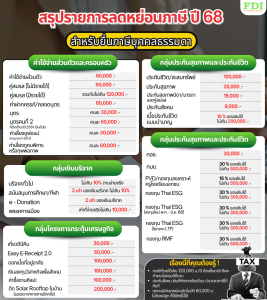
Tax allowances are benefits provided by law to taxpayers to further reduce the taxable base before calculating the actual tax payable.
Basic allowance category.
- Personal allowance for the income earner.
- Spouse allowance (in cases where the spouse has no income).
- Child allowance according to the specified conditions.
- Allowance for supporting parents or legally recognized persons with disabilities.
Insurance and savings category.
- Life insurance premiums.
- Health insurance premiums (for oneself and parents).
- Provident fund contributions.
- RMF / SSF / GPF / NSRF contributions, with a total not exceeding the legal ceiling (currently, the combined limit is 500,000 baht).
Other allowance category.
- Home loan interest.
- Donations for education or public benefit purposes (subject to a limit).
After deducting all allowances, the resulting amount is called net income, which serves as the basis for calculating the actual tax.
Step 4: Calculate tax using the progressive tax rates.
Thailand uses a progressive tax rate for personal income tax, meaning that the higher the net income, the higher the tax rate for each income bracket. The current tax rates are as follows:
- 0 – 150,000 baht: Exempt from tax.
- 150,001 – 300,000 baht: Tax rate 5%.
- 300,001 – 500,000 baht: Tax rate 10%.
- 500,001 – 750,000 baht: Tax rate 15%.
- 750,001 – 1,000,000 baht: Tax rate 20%.
- 1,000,001 – 2,000,000 baht: Tax rate 25%.
- 2,000,001 – 5,000,000 baht: Tax rate 30%.
- Over 5,000,000 baht: Tax rate 35%.
The calculation must be done separately for each bracket; you cannot apply a single rate to the entire net income.
Example of an easy-to-understand progressive tax calculation:
Mr. AA has an annual income of 580,000 baht, a personal allowance of 60,000 baht, and social security contributions of 9,000 baht. His tax can be calculated using the progressive rates as follows:
1. Total annual income: 580,000 baht
2. Deduct expenses: 100,000 baht (50% of 580,000 is 290,000, but the maximum deductible is 100,000).
3. Deduct personal allowance of 60,000 baht plus social security of 9,000 baht = 69,000 baht.
4. Net income: 580,000 – 100,000 – 69,000 = 411,000 baht.
5. Tax calculation:
Step 1: (0 – 150,000): Exempted = 0 baht.
Step 2: (150,001 – 300,000): (300,000 – 150,000) × 5% = 7,500 baht.
Step 3: (300,001 – 500,000): (411,000 – 300,000) × 10% = 11,100 baht.
Total tax payable. 0 + 7,500 + 11,100 = 18,600 baht
From the example above, it can be concluded that Mr. AA must pay tax in the amount of 18,600 baht.
Example of a simplified tax calculation formula.
The basic principle of tax calculation, summarized briefly, is:
- Formula to calculate net income:
Net income = Income – Expenses – Allowances
- Formula to calculate tax from net income:
Tax payable = Net income × Tax rate
Guidelines for maximizing tax deduction benefits for the 2026 tax year.
Taxpayers should start planning deductions at the beginning of the year, rather than waiting until the end, because some entitlements require investment or advance payment, such as funds or insurance.
Recommended guidelines include:
- Check all basic deduction entitlements to ensure you have claimed any government-supported programs, such as “Tour-D-Dee Mee Khuen” or others.
- Plan savings through RMF / SSF according to your own income level.
- Choose insurance that provides valuable coverage, suits your lifestyle, covers all aspects of your life, and can be legitimately used for tax deductions.
- Keep all types of documents and evidence complete.
Deduction information should be checked against the latest announcements from the Revenue Department each year, as conditions may change.
Calculating personal income tax is not complicated if you understand the process systematically, from totaling income, deducting expenses, applying allowances, to calculating tax using the progressive rates.
For the 2026 tax year, planning and using tax deductions appropriately will help income earners manage their taxes more effectively. This allows for lawful tax reduction while also promoting long-term financial discipline.
Contact Us
- Facebook: FDI Group – Business Consulting
- @fdigroup
- Phone : 02-642-6866, 02-642-6869, 02-642-6895
- E-mail : infojob@fdi.co.th
- Website : www.fdi.co.th

What accounting is required after opening a company? An essential checklist for new business owners to know, updated for 2026

What accounting tasks are required after starting a company? Checklist...
Read More
Company Tax: What Business Owners Should Know!
Many people view tax filing as merely a legal obligation, but in reality, taxes are an essential tool that helps business owners get a clearer financial overview of their business...
Read More
SME Tax Management Tips : Corporate Tax Deductions and Incentives Explained
SME entrepreneurs should pay attention to and need to have knowledge about taxes...
Read More