

Applying for a work visa in Thailand, particularly the Non-Immigrant B Visa, is one of the most frequently asked topics among foreign employees and investors. This is because there are several important aspects that both employers and employees must clearly understand before proceeding. Visa and work permit specialists from FDI Group have compiled the most common questions along with clear answers. This article gathers 10 frequently asked questions, providing straightforward explanations to help readers gain a better understanding.
Question: What is a Non-B Visa?
Answer The Non-Immigrant B Visa is a business visa issued to foreigners who wish to work or conduct business in Thailand. It is a crucial first step before applying for a Work Permit, which is required to legally work in Thailand. This visa is granted to individuals intending to enter Thailand for purposes such as employment or business activities. Generally, it allows a stay of up to 90 days. Once the Work Permit has been obtained, the visa holder may apply to extend the Non-B Visa for up to one year.
Question : How many types of Non-B Visa are there?
Answer : : There are two types, as follows:
1.Single-Entry: Valid for 3 months from the date of visa issuance and allows a stay in Thailand of up to 90 days.
2.Multiple-Entry: Valid for 1 year from the date of visa issuance and allows each stay in Thailand for up to 90 days per entry. This type is generally issued for business purposes only.
Question : : Is a Work Permit required together with a Non-B Visa?
Answer Even if you already have a Non-Immigrant B Visa, you are not allowed to work immediately. You must first obtain a Work Permit from the Department of Employment, which must be applied for separately after entering Thailand, within the specified timeframe.
Question : : What are the basic qualifications and conditions that employers and foreigners must know?
Answer For employers, it is essential to ensure that the company is legally registered, has the minimum registered capital required by law, and maintains the required ratio of Thai employees based on the type of business and number of foreign workers. Employers must also prepare complete employment certification documents. For foreign employees, they must first apply for a Non-Immigrant B Visa before entering Thailand and then apply for a
Work Permit from the Department of Employment after arrival. All documents, including passports and supporting paperwork, must be valid and not expired.
Question : What documents are required to apply for a Non-B Visa?
Answer The basic documents include: the visa application form (TM.7) with a photograph, a passport valid for at least 6 months, and a letter of employment or hiring confirmation from the Thai company. You can consult FDI for immediate guidance and support.
Question : Can you work if you have a Non-B Visa but no Work Permit?
Answer You cannot work even if you have a Non-B Visa, as it only serves as entry permission into Thailand. You must apply for a Work Permit and obtain authorization from the Department of Employment before you are legally allowed to work.
Question : How long is a Non-B Visa valid?
Answer After obtaining a Non-B Visa from the embassy, the typical authorized stay is about 90 days. Once you receive a Work Permit, you can apply to extend your stay for a longer period, such as 1 year, with the possibility of further extensions thereafter.
Question : What should you do if you change employers?
Answer In the case of changing jobs, both the former and new employers must notify the relevant authorities, as the Work Permit specifies the employing organization. If you change employers, you must apply to amend the Work Permit. Depending on the situation and the remaining validity of the visa, you may also need to apply for a new Non-B Visa or adjust your stay conditions accordingly.
Question : Can foreigners hold shares in a Thai company and apply for a Work Permit?
Answer It can be done, but careful consideration is needed regarding: Shareholding ratio , Foreign Business Act (FBA) restrictions, determining whether foreigners are allowed to engage in the business , Company structure In some cases, additional permits may be required, such as an FBL license or BOI privileges. You can consult FDI for detailed guidance and recommendations in this area.
Question : I have never applied for a Non-B Visa or Work Permit in Thailand. What should I do?
Answer Ease all your worries—just consult with us. We provide precise guidance, handle and prepare your documents, and act as your representative for submission. Our services are fast, affordable, and tailored for foreigners. Start the conversation with us today!
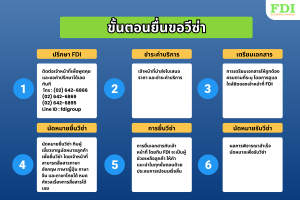
Handling work visas in Thailand (Non-B Visa and Work Permit) is not just a matter of submitting documents. It involves immigration law, labor law, company structure, registered capital, and employment conditions. Mistakes in the process can result in: Visa rejection , Delays in approval , Long-term impact on your legal work status in Thailand Proper guidance ensures compliance, smooth processing, and legal security for both employers and foreign employees.
Consulting with experts like FDI Group for visa and work permit services ensures a smooth and reliable process. Our team provides: Personalized case analysis for each individual , Accurate document verification , Integration of visa requirements with business structure , Continuous support from application submission to renewal or status changes This allows both employers and foreign employees to plan work in Thailand with confidence, save time, and avoid costs from potential mistakes—truly an investment in long-term business stability.
Contact Us
- Facebook: FDI Group – Business Consulting
- @fdigroup
- Phone : 02-642-6866, 02-642-6869, 02-642-6895
- E-mail : infojob@fdi.co.th
- Website : www.fdi.co.th
บริการรับต่อวีซ่า Work Permit ประหยัดเวลา บริการด้วยความเชี่ยวชาญ

บริการรับต่อวีซ่า Work Permit...
Read More
จัดตั้ง Holding company มีข้อดี–ข้อเสียอย่างไร? เรื่องที่เจ้าของธุรกิจควรรู้ก่อนจัดตั้ง
ตั้งบริษัทโฮลดิ้ง มีข้อดี–ข้อเสียอย่างไร? เรื่องที่เจ้าของธุรกิจควรรู้ก่อนจัดตั้ง...
Read More
วีซ่าธุรกิจ คือวีซ่าอะไร ต้องใช้เอกสารอะไรบ้าง ?
ไขข้อสงสัย วีซ่าธุรกิจและใบอนุญาตทำงาน (Work...
Read More