
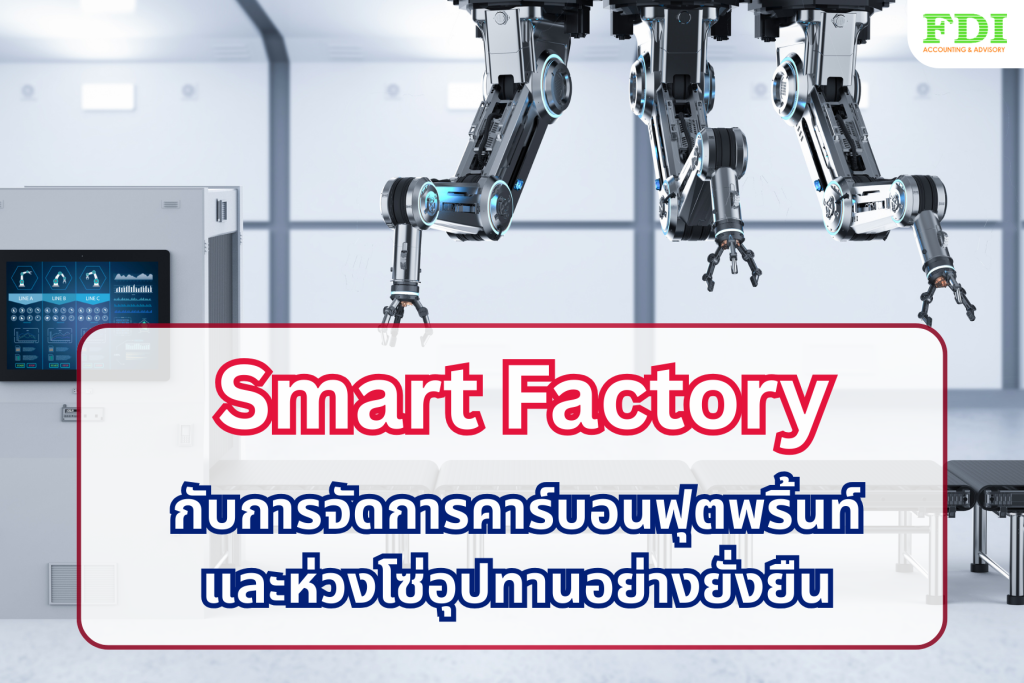
In an era where climate change has become a global risk, the industrial sector faces dual pressures: enhancing competitiveness through technology and concretely reducing environmental impact. In other words,
[1] Accurate carbon footprint assessment across the entire value chain has become a critical requirement for entering the global market, particularly under environmentally driven trade measures such as the European Union’s CBAM.
[2] A Smart Factory is therefore not merely a technological option, but a strategic management approach that integrates digitalization with sustainability goals. This article analyzes the role of smart factories in establishing comprehensive and effective systems for monitoring, measuring, and managing greenhouse gas emissions—forming a critical foundation for international certification and long-term competitive advantage.The Concept and Meaning of Smart Factory in the Context of Sustainability
A Smart Factory is a data-driven manufacturing ecosystem enabled through the deep integration of Information Technology (IT) and Operational Technology (OT) [3]. Its key distinction from traditional factories lies in breaking down data “silos” by connecting information from the operational level to the management level in real time. In the context of sustainability, a Smart Factory functions as an “environmental data processing center,” transforming every stage of production into quantifiable and traceable data related to energy consumption, raw material usage, and emissions. This enables environmental management to evolve from estimation to precise measurement and proactive management.
Technologies Driving Sustainability in Smart Factories
3.1 Sensor Networks and IoT Technologies Embedded sensors and IoT devices act as the factory’s “sensory organs,” continuously collecting data on machine-level energy consumption, process temperatures, and material flows [4]. This granular data enables the identification of energy loss hotspots and opportunities for improving resource efficiency that cannot be detected through traditional methods.
3.2 Advanced Data Analytics and Cloud Computing The vast amount of data collected from sensors is processed and analyzed using statistical tools and modeling techniques on cloud platforms. This analysis reveals complex relationships between production variables (such as machine speed and temperature) and carbon emissions, enabling the identification of eco-optimal parameters to minimize environmental impact [5].
3.3 Artificial Intelligence and Machine Learning (AI/ML) AI/ML algorithms can create predictive models for energy consumption and material demand by learning from historical and real-time operational data [6]. This supports optimized production scheduling and predictive maintenance, helping to avoid energy-wasting operations and reduce process-related waste.
3.4 Advanced Automation and Robotics Precision robotics and flexible automation systems enhance process consistency and accuracy, reducing rework and defect-related waste. This directly contributes to lower energy consumption and material use per unit of production [7].
The Role of Smart Factories in Carbon Footprint Management
Carbon footprint calculation under the GHG Protocol [8] covers three scopes, and Smart Factories help enhance accuracy at each level.
4.1 Scope 1 and 2 Real-time energy monitoring systems from machinery and utilities enable immediate tracking of direct emissions and purchased energy use, replacing calculations based on averages or static emission factors.
4.2 of Scope 3 Data is the most challenging category. Smart Factories support this by linking data with procurement and logistics systems, especially when combined with Digital Twin technology, which can simulate and assess the carbon impact of selecting different raw materials or suppliers before making commercial decisions [9].
Gaining Business Advantage through Supply Chain Data
A Smart Factory serves as a key data nexus in the green supply chain by exchanging environmental information (such as carbon labels of components) with partners through standardized platforms or interconnected ERP/SCM systems. This enables
5.1 Enhanced(Traceability) Track the origin and carbon emission history of raw materials from the very first moment.
5.2 Optimized Logistics Accurate production data helps plan transportation and warehousing efficiently, reducing empty runs and unnecessary inventory, which in turn lowers indirect carbon emissions.
5.3 Fostering Collaboration Across the Value Chain Transparent data encourages manufacturers and suppliers to collaboratively design processes and products to jointly reduce environmental impact (Co-innovation for Sustainability) [10].
Value Creation Beyond Cost Reduction
Beyond tangible energy and material savings, investing in a Smart Factory for sustainability also creates value across multiple dimensions, including:
6.1Regulatory Compliance Prepare for stricter environmental regulations in the future, such as CBAM, which require detailed and reliable carbon emission data [2].
6.2 Competitive Advantage in Accessing Capital Meets ESG (Environmental, Social, and Governance) investment criteria, which are increasingly prioritized by financial institutions and investors. [11]
6.3 BrandDifferentiation Build credibility and loyalty among environmentally conscious customers—a rapidly growing market segment.
6.4 Risk Management End-to-end visibility of supply chain data helps identify environmental risks and potential business disruptions that may arise from regulations or climate-related events.
- Challenges and Strategies for Overcoming Them
Key challenges in implementing Smart Factories for sustainability include:
7.1 Complexity of Scope 3 Data Collecting carbon emission data from multi-tier suppliers requires shared data standards and incentives for partners.
7.2 High Initial Investment and Payback Period Economic analysis is required, taking into account both direct and indirect values such as risk reduction and enhanced brand value—derived from the investment.
7.3 SkillsGap There is a demand for personnel with expertise in digital technologies combined with an understanding of product life cycle assessment (LCA) and carbon management [12].
7.4 Cybersecurity Increased network connectivity expands the attack surface, making robust security measures essential particularly for sensitive environmental data.
Future Trends: Moving Toward Carbon-Neutral Manufacturing
The future of Smart Factories is moving toward becoming “Self-Aware Factories” for sustainability, with anticipated integration of new technologies, including:
8.1 Blockchain Used to create an immutable and verifiable ledger for carbon credits and raw material tracking, helping to reduce greenwashing [13].
8.2 Inter-Organizational Sustainability Data Platforms The emergence of centralized or shared platforms (Data Cooperatives) allows industries to exchange standardized sustainability data without disclosing trade secrets.
8.3 EmbeddedCarbon Accounting The system automatically calculates the carbon footprint for each product unit in real time, which could serve as the basis for product labeling.
Conclusion and Recommendations for Implementation
In today’s context, Smart Factories have evolved from mere productivity tools into a core infrastructure for sustainable and resilient growth. They serve as a crucial bridge between business strategy and environmental responsibility.
For organizations considering this path, the following preliminary recommendations are offered:
- Start with a Baseline Assessment Understand the current state of energy use and data within the organization first.
- Develop a phased strategy focused on implementing pilot projects. Start with production lines or processes that offer clear sustainability and economic returns before scaling up.
- Prioritize data quality and adherence to standards. Design a data architecture from the outset that supports international carbon reporting standards, such as the GHG Protocol.
- Build partnerships and develop human capital. Collaborate with specialized consultants and technology providers, and invest in developing “Digital Green Skills” for your team.
The transition to a sustainable Smart Factory is not purely a technological race, but a competition in data-driven management for smart and responsible decision-making—ultimately determining who survives and who leads in the next era of industry.
ReferencesReferences)
[1] IPCC. (2022). Climate Change 2022: Mitigation of Climate Change. Contribution of Working Group III to the Sixth Assessment Report of the Intergovernmental Panel on Climate Change. Cambridge University Press. (แสดงให้เห็นแรงกดดันระดับโลกด้านสภาพภูมิอากาศต่อภาคอุตสาหกรรม)
[2] European Commission. (2023). Carbon Border Adjustment Mechanism: Detailed Guidance on Reporting Obligations. Publications Office of the European Union. (อธิบายรายละเอียดมาตรการ CBAM และผลกระทบต่อห่วงโซ่อุปทานระหว่างประเทศ)
[3] Kagermann, H., Wahlster, W., & Helbig, J. (2013). Recommendations for implementing the strategic initiative INDUSTRIE 4.0. Final report of the Industrie 4.0 Working Group. (ให้กรอบแนวคิดพื้นฐานของการบูรณาการ IT/OT ในอุตสาหกรรม 4.0)
[4] Da Xu, L., He, W., & Li, S. (2014). Internet of Things in Industries: A Survey. IEEE Transactions on Industrial Informatics, 10(4), 2233-2243. (อธิบายบทบาทและโครงสร้างของ IoT ในสภาพแวดล้อมอุตสาหกรรม)
[5] Wang, S., Wan, J., Li, D., & Zhang, C. (2016). Implementing Smart Factory of Industrie 4.0: An Outlook. International Journal of Distributed Sensor Networks, 12(1). (กล่าวถึงการประยุกต์ใช้การวิเคราะห์ข้อมูลใน Smart Factory)
[6] Lee, J., Bagheri, B., & Kao, H. A. (2015). A Cyber-Physical Systems architecture for Industry 4.0-based manufacturing systems. Manufacturing Letters, 3, 18-23. (นำเสนอกรอบการทำงานของระบบไซเบอร์-ฟิสิคัล ที่ใช้ AI/ML)
[7] The International Federation of Robotics (IFR). (2023). World Robotics Report 2023 – Industrial Robots. IFR Statistical Department. (ระบุแนวโน้มและผลกระทบของระบบอัตโนมัติและหุ่นยนต์ต่อประสิทธิภาพการผลิต)
[8] World Resources Institute & World Business Council for Sustainable Development. (2022). The Greenhouse Gas Protocol: A Corporate Accounting and Reporting Standard (Revised Edition). (เป็นมาตรฐานสากลหลักสำหรับการคำนวณคาร์บอนฟุตพริ้นท์)
[9] Tao, F., Zhang, H., Liu, A., & Nee, A. Y. C. (2019). Digital Twin in Industry: State-of-the-Art. IEEE Transactions on Industrial Informatics, 15(4), 2405-2415. (อธิบายแนวคิดและการประยุกต์ใช้ Digital Twin ในอุตสาหกรรม)
[10] Linton, J. D., Klassen, R., & Jayaraman, V. (2007). Sustainable supply chains: An introduction. Journal of Operations Management, 25(6), 1075-1082. (กล่าวถึงหลักการและความสำคัญของห่วงโซ่อุปทานที่ยั่งยืน)
[11] Global Sustainable Investment Alliance (GSIA). (2022). Global Sustainable Investment Review 2022. (แสดงขนาดและแนวโน้มของการลงทุนที่คำนึงถึงปัจจัย ESG)
[12] World Economic Forum. (2023). Future of Jobs Report 2023. (วิเคราะห์ความต้องการทักษะใหม่ โดยเฉพาะทักษะด้านเทคโนโลยีและความยั่งยืน)
[13] Kouhizadeh, M., Saberi, S., & Sarkis, J. (2021). Blockchain technology and the sustainable supply chain: Theoretically exploring adoption barriers. International Journal of Production Economics, 231, 107831. (ศึกษาบทบาทและความท้าทายของบล็อกเชนในการสร้างห่วงโซ่อุปทานที่ยั่งยืนและโปร่งใส)

Contact Us
- Facebook: FDI Group – Business Consulting
- @fdigroup
- Phone : 02-642-6866, 02-642-6869, 02-642-6895
- E-mail : infojob@fdi.co.th
- Website : www.fdi.co.th
รู้จักกับมาตรฐาน ISO 14064 และ ISO 14067 ที่เกี่ยวกับการลดคาร์บอน

รู้จักมาตรฐาน ISO 14064...
Read More
Want to start with ESG and don't know where to begin? ESG Consulting services can help.
What is ESG Consulting...
Read More
GRI Standard: The essential standard for ESG data disclosure for organizations
What is a GRI Standard?.
Read More