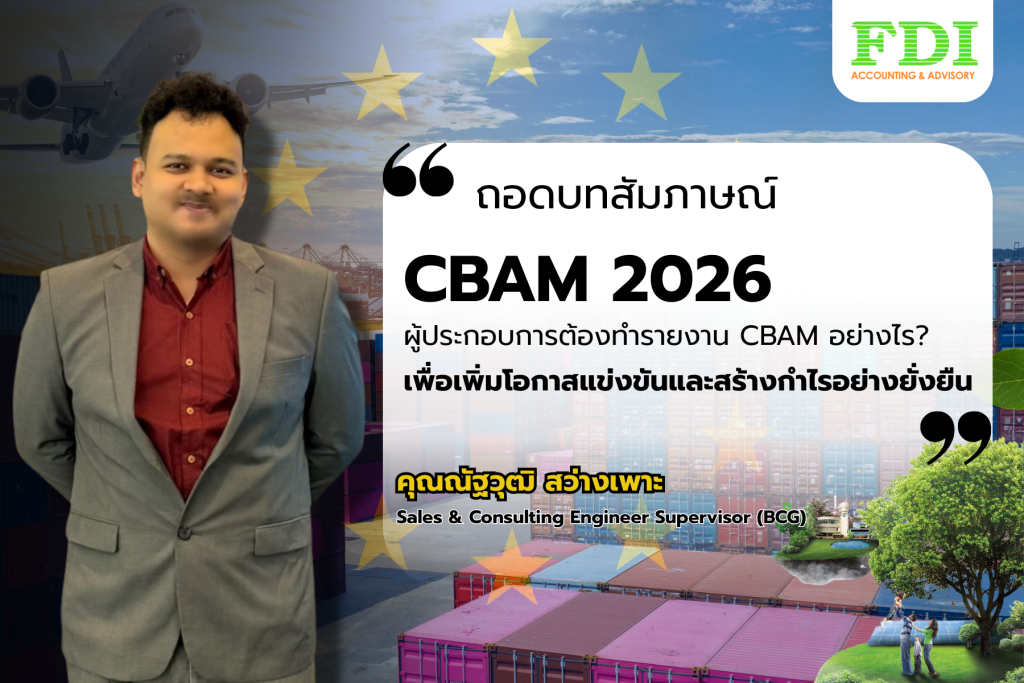
In a time when global economic shifts and environmental regulations are becoming increasingly stringent, 2026 clearly marks a significant milestone with the implementation of the CBAM (Carbon Border Adjustment Mechanism) CBAM is a mechanism introduced by the European Union (EU) that imposes a carbon price on certain imported goods with high greenhouse gas emissions. Its objective is to prevent carbon leakage and create a level playing field for EU producers who face higher carbon costs. Entrepreneurs who have proactively prepared in recent years undoubtedly hold a competitive advantage under this new framework. For those still in the process of adapting, FDI Group, in its role as a business advisory firm, is ready to provide guidance and ease concerns, helping entrepreneurs navigate CBAM requirements with confidence.
In this interview, we speak with a BCG expert, Mr. Nattawut Sawangpoh, Sales & Consulting Engineer Supervisor (BCG), who specializes in greenhouse gas inventory development. He is also officially registered as a consultant for Carbon Footprint for Organization (CFO) and Carbon Footprint for Product (CFP) assessments. Through this discussion, we will explore key insights, concepts, and real-world experience on the topic: ‘How Should Entrepreneurs Prepare CBAM Reports to Enhance Competitiveness and Achieve Sustainable Profitability?’ The conversation will cover everything from carbon data preparation and accurate reporting processes to strategic business adjustments aligned with new trade regulations that entrepreneurs should not overlook—along with practical recommendations for businesses moving forward.
In your role as a consultant providing environmental and sustainability advisory services to various organizations, what are your key responsibilities?
Throughout my experience as an environmental and sustainability consultant for various organizations, our role goes beyond assisting with greenhouse gas inventory preparation and reporting. We also support organizations in developing long-term sustainable growth strategies across economic, social, and environmental dimensions. This includes identifying opportunities to reduce costs in areas such as energy consumption and raw material usage, as well as planning more efficient and systematic logistics operations. Importantly, all these efforts must take into account stakeholders across the entire supply chain to ensure truly sustainable development. Therefore, our role is not limited to conducting assessments; we also provide practical solutions and strategic recommendations, offering alternative approaches for organizations to consider and implement in their pursuit of sustainability.
As we know, CBAM will begin applying actual carbon pricing in 2026. Which industrial sectors are affected and subject to the first phase of implementation? Are there plans to expand coverage to other product categories in the future?
In the initial phase (Transition Period) leading up to the full implementation of carbon pricing in 2026, CBAM covers 6 main product categories main product categories
- Iron and steel.
- Aluminum.
- Cement.
- Fertilizers.
- Electricity.
- Hydrogen.
Future Plans: The European Union (EU) plans to expand the scope of CBAM to cover additional products that fall under the EU Emissions Trading System (ETS) by 2030, such as plastics, chemicals, and downstream products that use materials from the initial six sectors as inputs.
What should Thai entrepreneurs prioritize and prepare first in relation to CBAM?
The first priority is establishing a greenhouse gas emissions database at the product level (Product Carbon Footprint). Entrepreneurs must begin collecting actual data on energy usage and production processes to accurately calculate embedded emissions in accordance with EU standards. Without company-specific data, the ‘default value’ will be applied, which is typically higher than actual emissions and may result in paying higher carbon costs than competitors.
What types of data are required for CBAM reporting? What are examples of documents and data reports needed, and how complex is the preparation process?
The required data includes:
- Quantitative data: Import volume of goods, direct greenhouse gas emissions (Direct Emissions), and indirect emissions (Indirect Emissions, such as electricity consumption).
- Examples of required documents : include quarterly carbon emission reports (CBAM Report), certified energy measurement verification documents, and evidence of carbon costs already paid in the country of origin (if applicable)
- Complexity: Since calculations must follow specific EU formulas and require verification by an accredited external body, the complexity extends beyond data collection alone. Accurately reporting emission factors and properly completing the official reporting forms are equally critical.
การเตรียมข้อมูลอย่างการประเมินคาร์บอนฟุตพริ้นท์ในรายงาน CBAM ต้องทำอย่างไรบ้าง ?
How should businesses prepare carbon footprint data for inclusion in a CBAM report?
- Define the(Boundary) : Identify which activities within the factory are directly related to the production of the specific product.
- Collect(Activity Data) : such as the quantity of fuel used, electricity consumption, and raw materials utilized in production.
- Calculate emissions: Multiply the activity data by the applicable emission factors in accordance with EU criteria.
- Prepare the report: Summarize the carbon emissions per unit of product (e.g., tCO₂e per ton).
It can be seen that all data involves an integration of both Corporate Carbon Footprint (CCF) reporting and Product Carbon Footprint (PCF) assessment. In preparation for the evaluation process, organizations are typically provided with foundational training on corporate carbon footprint concepts. This enables them to accurately classify and organize the relevant data required for reporting. Once the necessary data has been collected, the process moves into the assessment phase. At this stage, recognized emission factor databases are applied, including those from both national and international standards such as the Thailand Greenhouse Gas Management Organization (TGO), GHG Protocol, IPCC, and Ecoinvent. This approach ensures that organizations can be confident in the credibility and acceptance of the data sources used. By engaging our services, you can be assured that all underlying data and methodologies adhere to widely recognized standards and are fully reliable for reporting and verification purposes.
If exporting organizations begin planning and taking action now, will it truly deliver benefits and enhance their long-term sustainability?
It is not too late for organizations to start taking action now. However, as many have observed from recent global developments, climate conditions have become increasingly volatile and unpredictable. Every organization contributes to environmental impact to some extent. Without timely adaptation and strategic planning, businesses may fall behind—or even lose their ability to compete in an evolving global market. From a consultant’s perspective, organizations are strongly encouraged to raise awareness and begin their preparation within 2026. Competition in the global marketplace is intensifying, and consumers are increasingly prioritizing products with lower environmental impact. Whether in food, apparel, IT equipment, or even the automotive sector, products are now being evaluated based on their carbon footprint throughout their lifecycle. This transparency allows consumers to make more informed and environmentally conscious purchasing decisions, placing sustainability at the forefront of business competitiveness.
If exporters or organizations have no prior experience in preparing reports, how can they keep up in time?
As mentioned in the previous section, if you are wondering how to get started, FDI has a team of experts who are officially registered as consultants with the Thailand Greenhouse Gas Management Organization (TGO). We are fully equipped to support your organization across all projects. For every engagement, FDI provides training to relevant team members to ensure a clear understanding from the outset. Following the assessment, we deliver comprehensive results, actionable recommendations, and strategic guidance to help your organization transition toward becoming a Net Zero organization.
Finally, what would you like to leave with everyone who is reading this article?
“CBAM is not just about taxation it represents a new standard for global trade. While it may seem like a burden today, in the near future, products without environmental data will struggle to compete in the global market. Adapting today is not only about survival, but about building sustainability and creating opportunities to grow as a leader in the green economy.
If you are looking for a consultant who can provide close guidance and collaborate in strategic planning through proven techniques and deep advisory experience—integrating all dimensions of sustainability in alignment with your organization’s policies, strategies, and core values—you can connect with our team of experts immediately to explore service details and receive an initial consultation. We are ready to support you at any time.

Contact Us
- Facebook : FDI Group – Business Consulting
- @fdigroup
- Phone : 02-642-6866, 02-642-6869, 02-642-6895
- E-mail : infojob@fdi.co.th
- Website : www.fdi.co.th
รายงานความยั่งยืน คืออะไร? คู่มือขั้นตอน และวิธีจัดทำอย่างมืออาชีพ

รายงานความยั่งยืน คืออะไร? ทำไมธุรกิจยุคใหม่ไม่อาจมองข้าม...
Read More