
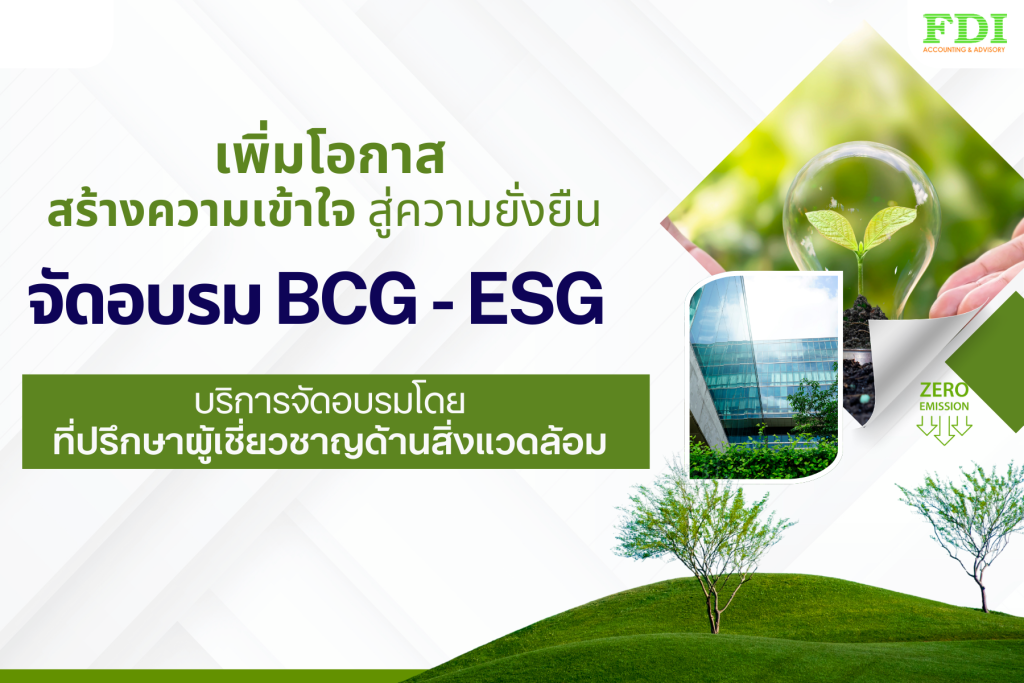
As the world faces increasingly severe global warming each year, organizations that fail to adapt may miss out on emerging business opportunities. If action begins only after competitors have already advanced, it may be too late — leading to a loss of opportunities in the green market or competitive disadvantages due to rising environmental taxes and stricter international regulations. For instance, businesses exporting goods to the EU will face higher taxes on six pilot product groups under the CBAM (Carbon Border Adjustment Mechanism), which will be fully enforced on January 1, 2026. Similarly, many regions worldwide are starting to adopt new environmental cooperation frameworks and agreements, reinforcing the urgency for organizations to prepare and act now.
Employee Training on ESG, Carbon Footprint, and Other Environmental Topics
As we all know, both globally and in Thailand, environmental management and sustainability policies have become increasingly emphasized. Governments are implementing measures and policies that encourage businesses to take greater responsibility for environmental and sustainability practices. Moreover, business partners are now requesting environmental performance reports from companies as part of their evaluation criteria. Therefore, organizations must plan and implement strategies to improve efficiency, reduce greenhouse gas emissions, and offset their carbon footprint. This includes initiatives such as increasing the use of clean energy and conducting Carbon Footprint assessments for both organizations and products to determine their total greenhouse gas emissions — providing valuable insights for future improvement and sustainable development.
3 Main Reasons for Conducting Employee Training Before Implementing Environmental Operations.
1. Develop a clear understanding of operations and coordinate data collection planning within the team to ensure efficient execution.
2.To build foundational knowledge and understanding through workshops guided by expert advice.
3.Foster an overall understanding of how operations connect to SDGs and ESG objectives in practice, including subsequent steps such as CBAM and Carbon Credit implementation.
To effectively implement carbon footprint initiatives or environmental operations for sustainability, it is essential that executives, relevant stakeholders, and operational-level employees understand the processes and follow consistent guidelines. They should have clear, shared objectives for data collection and implementation to maximize efficiency in reducing greenhouse gas emissions. This approach also supports long-term emission reduction planning, lowers organizational costs, develops new operational practices, and drives strategic environmental policies.

Examples of training content provided to various organizations.
- Understanding the concept of “Carbon Footprint for Organization (CFO).”
- Calculating greenhouse gas emissions from organizational activities according to Scope 1, 2, and 3, explaining each scope in an easy-to-understand way, and presenting real-world case studies from the industrial sector.
- Methods for collecting data on organizational activities, along with the tools and software used for calculations.
- Preparing reports in accordance with ISO 14064-1 standards.
- Practical alignment with SDGs and ESG objectives.
- Implementing CBAM and Carbon Credit projects.
Who should attend the training? For example:
Department heads and operational staff, including accounting, procurement, engineering, human resources, production, and others, depending on the organizational structure of each company.
The content above represents sample topics for training provided to various organizations by expert instructors registered as carbon footprint assessment consultants with TGO. The training follows the guidelines and standards set by TGO, and the topics can be adapted according to each industry and the organization’s policies to ensure relevance, understanding, and immediate practical application.
Environmental Risk Reduction Strategy for Thai Factories.
How conducting a workshop on data collection can help build understanding.
1.To help employees gain a better overall understanding of the carbon footprint.
Calculating the Carbon Footprint involves several components, such as:
- Scope 1: Direct emissions from sources under control (e.g., machinery fuel, vehicles).
- Scope 2: Indirect emissions from electricity consumption.
- Scope 3: Other indirect emissions (raw materials, transportation, waste, employee commuting).
The workshop helps participants “visualize organizational activities that generate greenhouse gas emissions” and correctly identify the relevant Scopes, reducing misunderstandings in data collection and improving the execution of each operational step.
2.Developing skills for collecting data from actual sources within the organization.
The challenge in preparing a Carbon Footprint is not just performing the calculations, but also collecting complete activity data, such as:
- Monthly diesel consumption.
- Monthly electricity usage (in kWh).
- Weight of waste sent for disposal.
- Employee travel records.
The workshop helps participants understand what data to collect, from which departments, and in what format, in order to reduce errors in the organization’s carbon accounting.
3.Minimize errors from misunderstandings or misinterpretations, ensuring operations are carried out more efficiently.
Without prior training and orientation, incomplete understanding may occur, such as:
- Thinking that electricity consumption alone constitutes the entire Carbon Footprint.
- Misunderstanding that Scope 3 is not necessary.
- Calculating using outdated emission factors.
4.Increase employee engagement and promote a green organizational culture.
Conducting workshops allows employees to feel “involved,” not just listening, but actively calculating, analyzing, exchanging ideas with colleagues, and forming an internal Green Team within the organization.
For example, a medium-sized company in Samut Sakhon successfully established a “Green Data Tracker” team after the training. The team collaboratively collected fuel, water, and waste data accurately and consistently, enabling faster operations with minimal errors.
Comprehensive Environmental Training Services for Organizations.
Consulting services for in-house training and workshops, providing guidance on data preparation for organizational Carbon Footprint assessments (Carbon Footprint for Organization, CFO) and product Carbon Footprints (Carbon Footprint of Products, CFP). Services include data collection, analysis, and support to accurately calculate carbon footprints in accordance with greenhouse gas accounting standards, using both Thai and international standards such as TGO, GHG Protocol, PCAF, and IPCC. Additionally, guidance is provided for carbon label registration certified by the Thailand Greenhouse Gas Management Organization (TGO).
FDI Group: Comprehensive Carbon Footprint Consulting and Environmental Expert Team.
FDI Group is committed to continuously developing services that meet the evolving needs of our clients. We strive to enhance our offerings across all dimensions, unlocking the full potential of every business to achieve sustainable, exponential growth. We believe that every organization taking steps to reduce greenhouse gas emissions recognizes the importance of environmental responsibility and the need for collaboration across all sectors. The goal is to accelerate emission reductions as quickly as possible for the sustainability of the environment, Thai society, and the global community. Since 2023, FDI has been providing environmental consulting servicesFDI began providing environmental consulting services to various companies in 2023 and has since offered professional guidance to over 60 companies, with more than 70 projects completed in the past year.
categorized into three groups as follows
1.Companies undergoing in-house training to prepare for Carbon Footprint assessment.
2.Companies currently in the process of data preparation and assessment for registration.
3.Companies that have completed Carbon Footprint assessment and registration.
We provide consulting services through experts registered with TGO, of which there are fewer than 300 in Thailand.
- Specialized employee training (industry-specific).
- Assessment of Carbon Footprint for organizational (CFO) and Carbon Footprint product (CFP).
- Development of ESG / SDGs / Net Zero Roadmap systems.
- Consulting services for CBAM Certification and Carbon Credit.
- Including environmental and sustainability projects within the organization.
You can consult us for free through the following contact channels.
- Facebook: FDI Group – Business Consulting
- @fdigroup
- Phone : 02-642-6866, 02-642-6869, 02-642-6895
- E-mail : infojob@fdi.co.th
รู้จักกับมาตรฐาน ISO 14064 และ ISO 14067 ที่เกี่ยวกับการลดคาร์บอน

รู้จักมาตรฐาน ISO 14064...
Read More
Want to start with ESG and don't know where to begin? ESG Consulting services can help.
What is ESG Consulting...
Read More
GRI Standard: The essential standard for ESG data disclosure for organizations
What is a GRI Standard?.
Read More