

What is Corporate Income Tax Filing, and What Are the Key Steps Every Business Owner Should Know?
Corporate income tax,or corporate income tax liability, is the tax levied on companies or organizations registered as legal entities, including limited companies, public limited companies, juristic partnerships, foundations, or associations that operate and generate income. The key characteristic of corporate income tax is that it is imposed on a company’s net profit, calculated by deducting business-related expenses from total revenue. The standard tax rate is 20% of net profit, and certain types of expenses are eligible for corporate tax deductions. Corporate income tax filing consists of two main periods: Mid-year filing (Form P.N.D. 51): to be submitted within August each year. Annual filing (Form P.N.D. 50): to be submitted within 150 days from the end of the accounting period.

Which types of juristic persons are required to pay corporate income tax ?
For certain organizations or groups of companies registered as juristic persons, there are specific criteria for paying corporate income tax. Filing corporate income tax properly ensures that the company operates in compliance with the law. Companies that file taxes accurately and transparently gain trust and credibility from clients, investors, and financial institutions. The types of juristic persons required to pay corporate income tax include:
1.Juristic persons established under Thai law, such as limited companies, public limited companies, limited partnerships, and registered ordinary partnerships.
2.Juristic persons established under foreign law These include businesses operating in Thailand, those conducting business both in Thailand and abroad, entities engaged in transportation connected with Thailand, and those earning income from Thailand without actually operating a business in the country. This also covers entities that transfer or remit profits abroad but receive income from Thailand, such as fees, royalties, interest, and dividends.
3.3.Joint Venture. It refers to a collaboration between two or more parties to conduct a specific business or project without merging their entities, while each party maintains its own legal status. The cooperation is formed for the purpose of generating profit and may involve various combinations such as company-to-company, company-to-juristic partnership, juristic partnership-to-juristic partnership, or even between a juristic person and an individual or group of persons.
4.Businesses engaged in commercial or profit-making activities established by foreign governments, foreign government agencies, or other juristic persons incorporated under the laws of those foreign countries.
5.Juristic persons approved by the Director-General, authorized by the Minister, and published in the Government Gazette: recognized as a company or juristic partnership under the Revenue Code.
6.Non-profit foundations or associations that engage in activities generating income this includes foundations with income (excluding public charitable organizations) and associations with income (excluding public charitable organizations).
Which types of juristic persons are exempt from corporate income tax?
Entities exempt fromcorporate income tax are divided into two main groups: Entities exempt by status: These include Thai government agencies (ministries, bureaus, departments), government organizations, cooperatives, and other juristic persons established under Thai law.Entities granted special exemptions under the law: These include companies promoted by the Board of Investment (BOI), companies exempted under international cooperation agreements between Thailand and other countries, and companies from countries that have a double taxation treaty with Thailand (subject to the conditions specified in the treaty).
Where can corporate income tax returns be filed?
There are two ways to file corporate income tax returns: filing at the Revenue Department in person or filing online.
1.Filing at the Revenue Department in person
For filings in Bangkok: returns can be submitted at the branch of the Revenue Department where the company’s headquarters is located.For filings in other provinces: returns can be submitted at the local Revenue Department office, which can be located using the following method.
1.1 For juristic persons and individuals whose domicile or registration is in that province, or to find the nearest local Revenue Department office, visit: https://www.rd.go.th/
1.2 Local branches of the Revenue Department havesub-branches in each district or area. Returns can be filed at the district office or local sub-district office where the company’s headquarters is located. You can also consult the staff for additional information.
2.Filing online
Step 1: Register to access the e-Filing system
If you do not yet have an account
- Go to the Revenue Department’s website : https://efiling.rd.go.th
- Click “Register” to create a user account.
- Enter the company’s information, such as the 13-digit tax identification number, company name, and responsible person’s details.
- Set a password and save the information to access the system.
If you already have an account
- Log in using your tax identification number and password.
Step 2: Select the tax form to be filed After logging in, select the “File Tax Return” menu and choose the type of tax you want to file, such as:
- P.N.D. 50 (Annual Corporate Income Tax Return)
- P.N.D. 51 (Mid-Year Corporate Income Tax Return)
- P.P. 30 (Value Added Tax – VAT)
- P.N.D. 3, 53 (Withholding Tax)
Step 3: Fill in the form. The system will display the selected tax form. Enter the required information as specified, such as:
- Revenue :
- Expenses
- net profit
- Calculate the tax payable.
Step 4: Attach supporting documents (if any).
- For P.N.D. 50 or P.N.D. 51 filings, you must attach financial statements, such as the income statement, balance sheet, and auditor’s report. The system accepts PDF files within the specified file size limit.
Step 5: Submit the tax form and receive the filing confirmation.
- Click “Submit Tax Return”.
- The system will display a reference number and the receipt.
- Download the “Filing Confirmation” and keep it as a record.
Step 6: Pay the tax
If there is tax payable,
you can choose an online payment method to settle the tax.
- Pay via internet banking (through participating banks).
- Pay via credit or debit card.
- Pay at a bank counter (print the payment slip and pay at the bank).
- Pay via QR Code (scan using a banking app).
Step 7: Check the status of your tax filing
- Go back to the “Tax Filing Status” page.
- Check whether your tax return has been approved.
- If any errors are found, make corrections and resubmit the tax return.
For guidance on filing and detailed procedures, you can refer to the Revenue Department’s website.
Key Points to Know About Filing Corporate Income Tax Online
Tax filing deadlines
- P.N.D. 50 → Within 150 days from the end of the accounting period
- P.N.D. 51 → Within 2 months after the first half of the accounting period
- P.P. 30 / P.N.D. 3, 53 → By the 15th day of the following month
In cases of late filing
- There are penalties and interest charges for late payment.
- The company may also be subject to an audit by the Revenue Department.
In summary, corporate income tax is a tax levied on the net profit of a company or organization registered as a juristic person. It is calculated by deducting business-related expenses from total revenue. The standard tax rate is 20% of net profit, and certain company expenses may be eligible for tax deductions.
Corporate income tax filing includes mid-year filing (P.N.D. 51), which must be submitted by August, and annual filing (P.N.D. 50), which must be submitted within 150 days after the end of the accounting period. Filings can be done online or in person at the local Revenue Department office.
Maintaining corporate accounting is essential for company operations. Tax laws are complex and constantly changing, making proper accounting and tax planning increasingly important for smooth business operations.
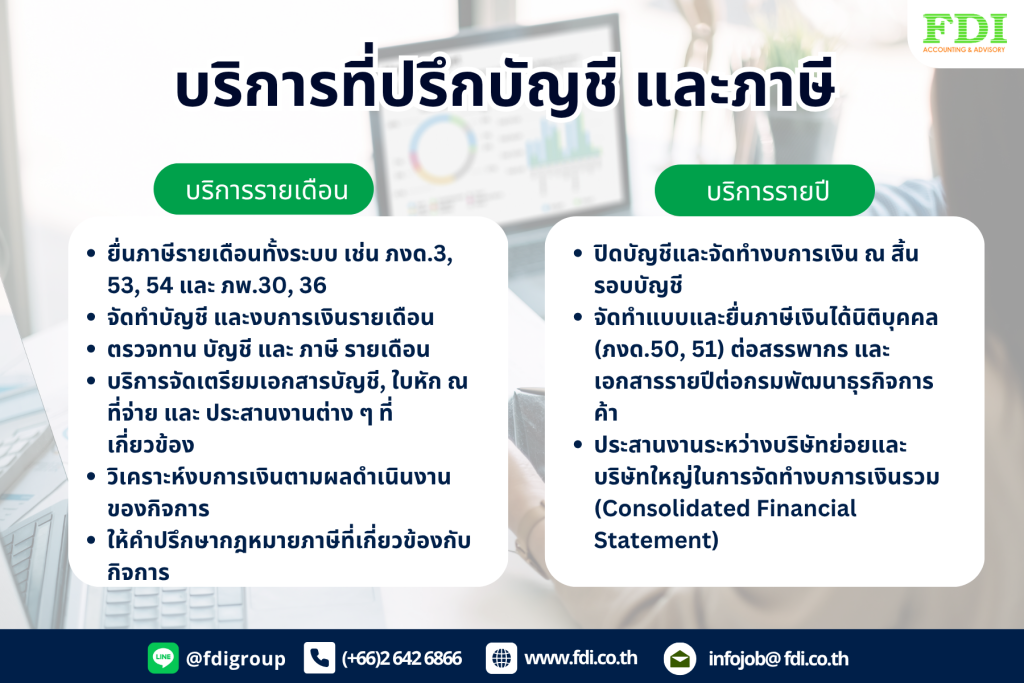
FDI is an accounting and tax advisory firm specializing in corporate clients.We are dedicated to supporting your business towards a sustainable future with accounting and tax planning advisory services. Our team of experts, with deep experience and knowledge, is here to help you achieve your goals for a sustainable business
Contact Us!
- Facebook FDI Group – Business Consulting
- Line @fdigroup
- Phone : 02 626 5999
- E-mail : infojob@fdi.co.th
- Website : www.fdi.co.th

เปิดบริษัทแล้วต้องทำบัญชีอะไรบ้าง ? Checklist สำคัญที่เจ้าของธุรกิจมือใหม่ต้องรู้ อัปเดต 2026

เปิดบริษัทแล้วต้องทำบัญชีอะไรบ้าง ? Checklist...
Read More
Company Tax: What Business Owners Should Know!
หลายคนมองว่าการยื่นภาษีเป็นเพียงภาระที่ต้องปฏิบัติตามกฎหมาย แต่ในความเป็นจริง ภาษีคือเครื่องมือสำคัญที่ช่วยให้เจ้าของกิจการมองเห็นภาพรวมทางการเงินของธุรกิจได้ชัดเจนยิ่งขึ้น...
Read More
SME Tax Management Tips : Corporate Tax Deductions and Incentives Explained
ผู้ประกอบการ SME ควรใส่ใจและจำเป็นที่จะต้องมีความรู้เรื่องภาษี...
Read More