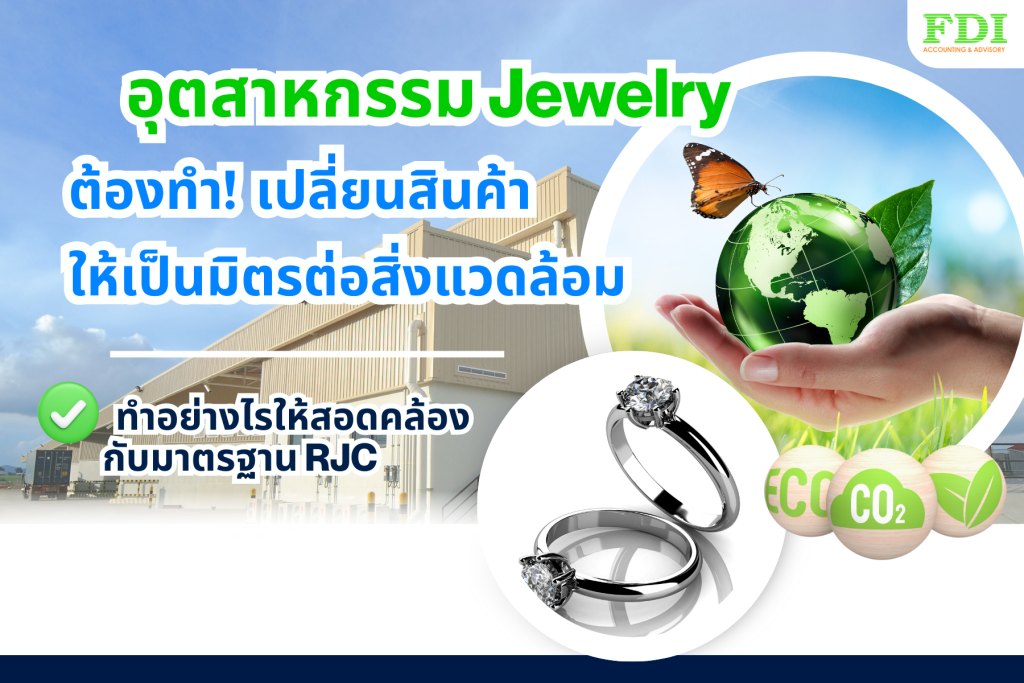
Increase sustainable profits for your jewelry factory through environmental responsibility in alignment with RJC standards.
This is not a new topic for business operators in 2025, but it can be considered a new challenge that requires greater attention and concrete action in the areas of environmental responsibility and sustainability, which are among the key **standard requirements of the RJC.
According to a report by the World Jewellery Confederation (CIBJO) the jewelry industry contributes significantly to greenhouse gas emissions, particularly during the upstream stages of the supply chain, as well as other operational processes. This presents a major challenge in an era where the world is becoming increasingly conscious of environmental crises — both from international business partners and modern consumers. Data also shows that over 72% of consumers, particularly Gen Z, believe that companies should demonstrate environmental transparency (Deloitte, 2024). This further reinforces the fact that the majority of people are placing greater importance on environmental and sustainability practices than ever before.
The jewelry industry is another major sector receiving increasing attention especially manufacturing factories, which are at the upstream end of the supply chain. These producers are now facing a crucial question: How can they achieve growth while protecting the environment? What actions and strategic plans are needed to ensure sustainable profitability that can be truly realized?
Transform your factory into an environmentally friendly operation in alignment with RJC standards.
Responsible Jewellery Council (RJC) It is an international standard for businesses in the jewelry industry that emphasizes transparency, ethics, and sustainability.
What is the Responsible Jewellery Council (RJC)?
The RJC standard includes the following key requirements:
- Environmental Aspect: Focuses on standards for waste and pollution management, efficient use of energy and raw materials, and promoting environmental sustainability.
- Human Rights, Labor, and Social Practices: Focuses on legally protecting labor rights, respecting human rights, managing human resources effectively, and ensuring fair treatment of all stakeholders.
- Business Ethics : Covers transparent, honest, and fair business operations with accountability, upholding high ethical standards in compliance with relevant laws.
- Supply Chain Responsibility: Traceability of metal and gemstone sources, effective system management, monitoring, evaluation, and operational processes.

The Thai jewelry industry and the importance of complying with environmental standards
In the past, jewelry production was seen as a business of beauty emphasizing craftsmanship, delicacy, and material value. However, in today’s world, especially from 2025 onward, the global jewelry industry is facing growing expectations to transform its operations in ways that positively impact the planet and society. Environmental adaptation has become a key focus, as activities such as precious metal mining, polishing, coating, and the use of energy and chemicals in factories all contribute to greenhouse gas emissions and the generation of hazardous waste. This increasing scrutiny of the industry underscores the necessity for businesses to comply with environmental standards and integrate sustainability into every stage of production.
If you want to implement environmental initiatives, where should you start and how should you make improvements?
Environmental and sustainability experts offer the following basic recommendations for jewelry factories to align their operations with RJC environmental standards:
1.Set targets for reducing greenhouse gas emissions and conduct internal training to raise employee awareness and align organizational goals. Establish a systematic plan for collecting data on energy and raw material usage, with clear steps and transparent methods to ensure accurate and efficient energy data management.
2. Conduct a Carbon Footprint assessment to identify which processes emit higher or lower levels of greenhouse gases, helping prioritize areas for reduction and improvement.
3. Inspect and select raw materials from traceable and certified sources with clear and reliable information for example, recycled gold or lab-grown diamonds.
4. Develop a plan to reduce the use of chemicals, such as coating acids or materials that contaminate wastewater.
5. Seek consultation from environmental and sustainability experts to ensure that operations are carried out correctly and efficiently, providing precise and effective guidance tailored to your organization’s needs.
In summary, it is essential for Thailand’s jewelry industry to place greater emphasis on environmental responsibility. Doing so enables businesses to present credible environmental performance data to partners and enhances new business opportunities. The business landscape is evolving rapidly, and the expectations of both consumers and partners now go beyond product quality — they also encompass ethical production practices and the impact on the planet. Therefore, environmental awareness is no longer just a matter of brand image, but a strategic business approach a key factor that can strengthen competitiveness and create sustainable growth opportunities for Thai jewelry manufacturers.

FDI Group, as an environmental consulting firm, is ready to support all Thai factories striving to achieve world-class standards through internationally recognized and practical approaches. We focus on delivering benefits to the community, society, and the environment, while helping businesses adapt their strategies to fit the specific context of the Thai jewelry industry. Our team provides comprehensive consulting services, guiding every organization with confidence toward global standards and sustainable profitability.
Contact Us
- Facebook : FDI Group – Business Consulting
- @fdigroup
- Phone : 02-642-6866, 02-642-6869, 02-642-6895
- E-mail : infojob@fdi.co.th
- Website : www.fdi.co.th
รายงานความยั่งยืน คืออะไร? คู่มือขั้นตอน และวิธีจัดทำอย่างมืออาชีพ

รายงานความยั่งยืน คืออะไร? ทำไมธุรกิจยุคใหม่ไม่อาจมองข้าม...
Read More